×
● Active · Solar Observatory · L1 Lagrange Point

ADITYA-L1

India's first dedicated solar observatory — stationed 1.5 million kilometres from Earth at the L1 Lagrange point, staring at the Sun continuously, studying its corona, solar winds, and the space weather that affects every satellite and power grid on Earth.

Watch: Aditya-L1 Launch Live
1st
Indian Solar Observatory
1.5M km
Distance from Earth
7
Science Payloads
5yr
Mission Design Life
Active
Status · 2026
Overview The L1 Point 7 Instruments Discoveries Timeline Why It Matters

India Watches the Sun

Aditya-L1 — named after Aditya, the Sanskrit name for the Sun — is India's first space-based solar observatory. Launched on September 2, 2023, it reached its destination on January 6, 2024, becoming the first Indian spacecraft to operate at a Lagrange point.

The L1 point is a gravitational sweet spot between the Earth and the Sun — 1.5 million kilometres from Earth — where a spacecraft can maintain a stable position with minimal fuel expenditure. From here, Aditya-L1 has an uninterrupted, continuous view of the Sun, 24 hours a day, 365 days a year — never blocked by Earth's shadow.

This matters because the Sun is not predictable. Solar flares, coronal mass ejections, and solar wind variations can knock out satellites, disrupt GPS, overload power grids, and endanger astronauts. Aditya-L1's job is to watch, warn, and help scientists understand the star that makes all life on Earth possible.

What is Space Weather?
Solar eruptions can send charged particles hurtling toward Earth at millions of km/h. These interact with Earth's magnetic field and ionosphere — disrupting radio communications, damaging satellites, and in extreme cases, knocking out power grids for millions of people. Aditya-L1 provides early warning — like a weather station for solar storms.
ACTIVE
Mission Status · May 2026
Launch
Sep 2, 2023
L1 Insertion
Jan 6, 2024
Distance
1.5
Million km
Spacecraft Mass
1,475
kg
Launch Vehicle
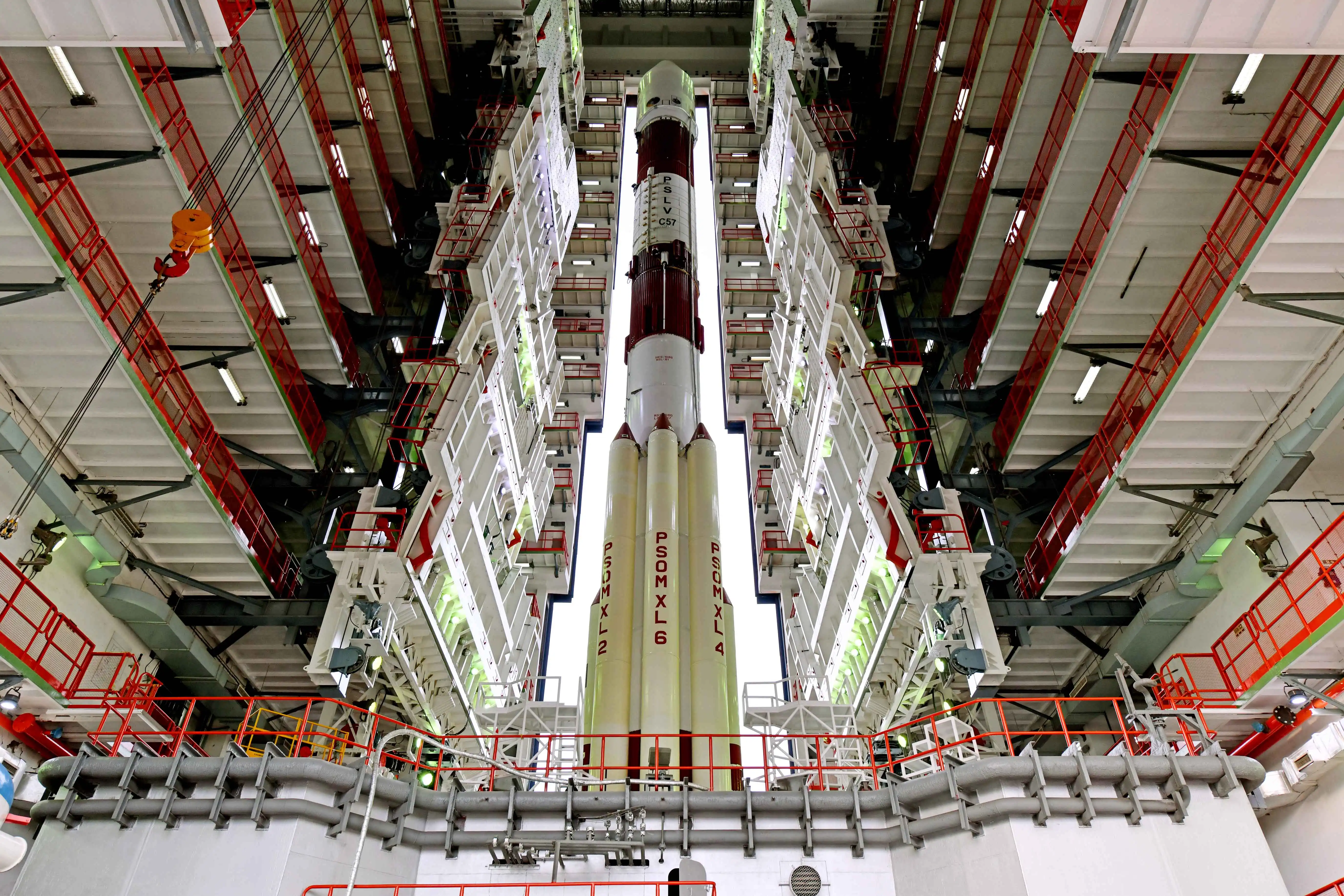
PSLV-C57
Payloads
7
Location

The L1 Lagrange Point

The five Lagrange points are positions in space where the gravitational forces of two large bodies — in this case, the Sun and Earth — and the centrifugal force of an orbiting object perfectly balance. At L1, a spacecraft between the Earth and Sun is gravitationally "parked" — it requires very little thrust to maintain its position.

L1 is 1.5 million kilometres from Earth — about 1% of the Earth-Sun distance. From here, Aditya-L1 has a permanent, unobstructed view of the Sun that no Earth-based or Earth-orbiting telescope can match.

ESA's SOHO mission and NASA's ACE mission have operated at L1 for decades. Aditya-L1 joins this elite group — making India one of only a handful of nations to station a spacecraft at a Lagrange point.

On January 6, 2024, ISRO executed the final burn to insert Aditya-L1 into its halo orbit around L1. The L1 point is technically unstable — without occasional corrections, a spacecraft would slowly drift away. ISRO performs station-keeping manoeuvres every few weeks, making small thruster firings to maintain the precise halo orbit. This requires careful navigation and planning — and ISRO's mission operations team does it flawlessly.

Why L1 is Perfect for Solar Observation
At L1, there are no orbital eclipses — the Sun is always in view. The data stream is continuous. Solar events can be detected with maximum lead time before their effects reach Earth. This gives scientists up to an hour of advance warning before a solar storm impacts Earth's technology.
L1 Distance
1.5M km
% of Earth-Sun Dist.
1
%
Sun Always Visible
Yes
Halo Orbit Insertion
Jan 6, 2024
Station-Keeping
Every Few Weeks
Warning Time
~1
Hour advance
Science Payloads

7 Instruments · 7 Ways to See the Sun

Remote Sensing Payloads · Looking at the Sun
VELC · SUIT · SoLEXS · HEL1OS
Observe the Sun's corona, UV emissions, and X-ray flares from a distance
In-Situ Payloads · Measuring the Local Environment
ASPEX · PAPA · MAG
Measure solar wind, plasma, and magnetic field right at the L1 point
🔭
VELC
Visible Emission Line Coronagraph — the primary instrument. Observes the Sun's corona as close as 1.05 solar radii from the Sun's surface — closer than almost any other space-based coronagraph in history — enabling unprecedented study of the inner corona and CME initiation zones.
☀️
SUIT
Solar Ultraviolet Imaging Telescope — images the solar photosphere and chromosphere in UV using 11 unique narrowband and broadband filters, each revealing a different layer of the solar atmosphere. Observed a rare plasma ejection in April 2026 — a first-of-its-kind observation in this wavelength.
🌟
SoLEXS
Solar Low Energy X-ray Spectrometer — monitors soft X-ray flares from the Sun in the 2 to 22 keV energy range, covering the full spectrum of solar flare intensity from minor B-class to extreme X-class events.
HEL1OS
High Energy L1 Orbiting X-ray Spectrometer — studies hard X-ray flares and burst events from the Sun.
🧲
ASPEX
Aditya Solar wind Particle EXperiment — studies solar wind properties and energy distribution of protons and alpha particles.
🌊
PAPA
Plasma Analyser Package for Aditya — measures solar wind ions and electrons to understand the Sun's particle environment.
📡
MAG
Advanced Tri-axial High-Resolution Digital Magnetometer — measures in-situ magnetic field variations at the L1 point.
Active Science · 2024–2026

What Aditya-L1 Has Found

🌋
Powerful Solar Flare Observed · 2026
SUIT observed a powerful solar flare and — in a first-of-its-kind observation — captured a rare plasma ejection in ultraviolet light that no other instrument had documented before.
🧲
Geomagnetic Disturbance Explained
Aditya-L1 measurements helped explain unusual dawn-time geomagnetic disturbances during strong solar storms — resolving a puzzle that had confused scientists for years.
🌐
Landmark Solar Storm Study
Aditya-L1 joined a global coordinated effort studying a major solar storm event — contributing Indian data to the international scientific community for the first time from L1.
🛡️
Earth's Magnetic Shield Decoded
Aditya-L1's data decoded the impact of a powerful solar storm on Earth's invisible magnetic shield — improving models used to protect satellites and power infrastructure globally.
ISRO-ESA Joint Heliophysics Workshop · 2026
In 2026, ISRO and ESA jointly organised a Heliophysics Workshop bringing together data from Aditya-L1, ESA's Solar Orbiter, and ESA's Proba-3. India is now a core partner in global solar science — not just a participant, but a contributor of unique data no other mission provides.

In Pictures

Swipe or click arrows to browse. Click any photo to zoom.
Mission Timeline

Launch to L1 and Beyond

Sep 2, 2023
Launch — PSLV-C57, Sriharikota
Aditya-L1 lifts off on PSLV-C57 XL. Inserted into Earth parking orbit. Journey to L1 begins.
Sep–Dec 2023
Earth Orbit Manoeuvres + Trans-L1 Injection
Multiple orbit-raising manoeuvres. Trans-Lagrangian Point 1 insertion burn executed successfully. Spacecraft en route to L1 point.
Jan 6, 2024
L1 Halo Orbit Insertion — India's First Lagrange Point Mission
Aditya-L1 enters halo orbit around L1 — 1.5 million km from Earth. India becomes one of a handful of nations to operate a spacecraft at a Lagrange point. Science operations begin.
Jan 2024
First Science Data Released
ISRO releases first datasets from all seven instruments on ISSDC and PRADAN portals — available to scientists worldwide.
2024–2026
Continuous Solar Observation
Aditya-L1 monitors solar activity continuously. Observations of solar flares, CMEs, and solar wind variations contribute to global space weather databases and scientific publications.
2026 · Ongoing
Active — India's Solar Sentinel
Aditya-L1 continues operations. ISRO and ESA joint workshops ongoing. Second Announcement of Opportunity cycle for observations opened. India's eyes remain fixed on the Sun.
Why It Matters

India's Solar Sentinel

🛰️
Protecting Earth's Technology
Every satellite in orbit, every GPS system, every power grid is vulnerable to solar storms. Aditya-L1's early warning data helps agencies worldwide protect critical infrastructure — India is contributing to global safety.
🌍
India at L1 — An Elite Club
Only ESA (SOHO) and NASA (ACE, WIND, DSCOVR) have previously operated science missions at L1. India is now in this club — the only developing nation with a spacecraft at a Lagrange point.
🔬
Open Data for the World
ISRO's data from Aditya-L1 is publicly available. Scientists from any country can request observations and analysis. India is contributing to solar physics globally — not just for India.
🚀
Essential for Gaganyaan Safety
Human spaceflight is directly affected by solar weather. Aditya-L1's real-time monitoring will help ISRO make informed go/no-go decisions for Gaganyaan missions — protecting India's astronauts.
Ground Segment

IDSN — India's Deep Space Ears

Every command ISRO sends to Aditya-L1 at 1.5 million km, and every byte of solar data it returns, passes through the Indian Deep Space Network (IDSN) at Byalalu, Karnataka — 60 km from Bengaluru. The IDSN operates 18-metre and 32-metre parabolic dish antennas that can precisely track and communicate with spacecraft across hundreds of millions of kilometres. At 1.5 million km, data from Aditya-L1 travels at the speed of light and arrives at IDSN with a ~5-second delay — but the processing pipeline is designed for near real-time space weather alerts, meaning a solar event detected by Aditya-L1 can trigger a global warning within minutes. Without IDSN, Aditya-L1 would be silent.

Next Mission
Chandrayaan-1 — Water on the Moon
India's First Lunar Mission · 2008
Explore Mission → All Missions