SLV-3
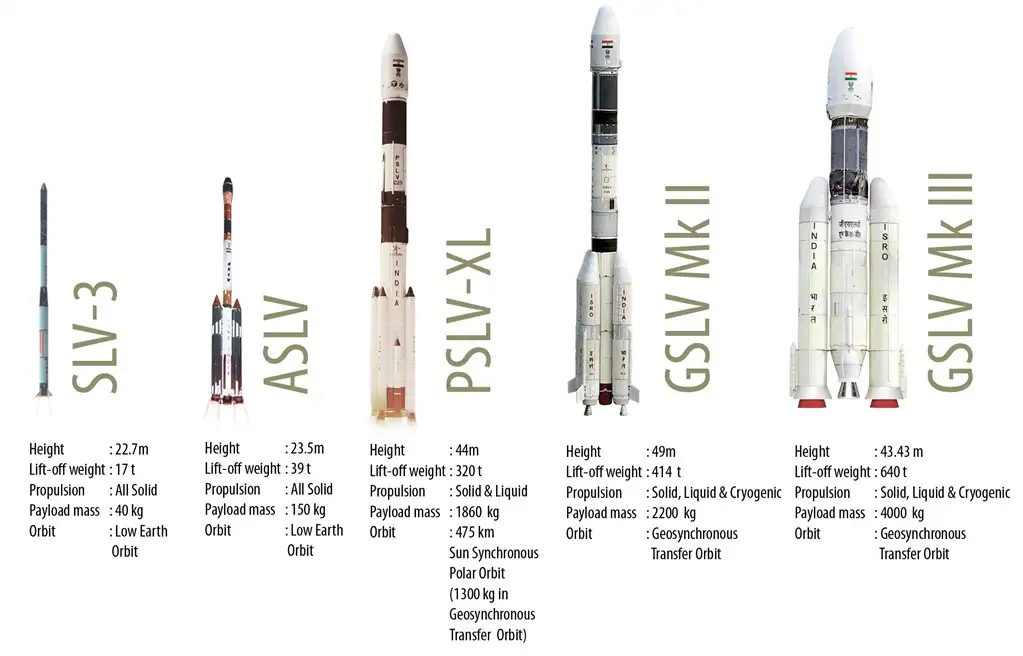
Satellite Launch Vehicle 3. India's first indigenous orbital rocket — four solid stages, built without foreign technology transfers. Placed Rohini RS-1 into orbit on July 18, 1980 and made India a spacefaring nation.
Height
22
metres
Liftoff Mass
17
tonnes
Stages
4
All Solid
Payload to LEO
40
kg
Total Flights
4
1979 – 1983
Status
Retired
SLV-3
No 3D model available
Stage 4
Solid propellant · 83 kN
Stage 3
Solid propellant · 267 kN
Stage 2
Solid propellant · 267 kN
Stage 1
Solid propellant (PVC) · 443 kN

SLV-3 was a decade-long indigenous effort led by A.P.J. Abdul Kalam as Project Director. With no foreign technology transfers permitted, ISRO built every component from scratch. The 1979 launch failed due to fourth-stage destabilisation, but the July 1980 launch was a complete success — Rohini RS-1 into a 305×919 km orbit. India became the sixth nation to develop its own satellite launch capability.

SLV-3's real legacy was the engineers it forged. Every team that built PSLV, GSLV, and LVM3 cut their teeth on SLV-3.
PSLV
Polar Satellite Launch Vehicle. 55+ consecutive successes. 50+ nations' satellites launched. The most reliable rocket in Asia. India's commercial launch flagship.
Height
44
metres
Liftoff Mass
320
tonnes
Stages
4
Solid-Liquid-Solid-Liquid
Payload to LEO
~3,800
kg (XL) · 3,200 kg (CA)
Payload to SSO
1,750
kg
Status
Active
Loading model…
drag to rotate
Stage 4
PS4 — Liquid (MMH/MON) · 7.6 kN
Stage 3
PS3 — Solid (HTPB) · 84 kN
Stage 2
PS2 — Vikas Engine · Liquid (UH25 / N2O4) · 800 kN
Stage 1
PS1 — Solid (HTPB) · 4,846 kN + 6 strap-on boosters

* UH25 = a blend of UDMH and Hydrazine Hydrate used in the Vikas engine — derived from the French Viking engine, indigenised by ISRO, with a perfect flight record across PSLV, GSLV, and LVM3.

PSLV's four-stage alternating solid-liquid design is its signature strength — solids for high thrust in the lower atmosphere, liquids for precise throttling at orbital insertion. The XL configuration adds six strap-on boosters for extra payload.

PSLV has launched Chandrayaan-1, Mangalyaan, Astrosat, Aditya-L1, and 104 satellites in a single flight. Its PS4 fourth stage, retained in orbit as POEM platforms, has hosted dozens of experiments — zero-waste space engineering.

GSLV Mk II
Geosynchronous Satellite Launch Vehicle Mark II. India's first indigenously cryogenic-equipped orbital rocket. The CE-7.5 engine — developed after technology denial — is a milestone of Indian aerospace engineering.
Height
49
metres
Liftoff Mass
415
tonnes
Stages
3
Solid + Liquid + Cryo
Payload to GTO
2,500
kg
Payload to LEO
5,000
kg
Status
Active
Loading model…
drag to rotate
Stage 3
GS3 — CE-7.5 Cryogenic (LH2/LOX) · 73.5 kN
Stage 2
GS2 — Vikas Engine · Liquid (UH25 / N2O4) · 800 kN
Stage 1
GS1 — Solid (HTPB) · 4,700 kN + 4 liquid strap-on boosters

GSLV Mk II introduced India's indigenous cryogenic stage — the CE-7.5 engine burning liquid hydrogen (−253°C) and liquid oxygen (−183°C). The United States pressured Russia in 1992 to block cryogenic technology transfer to India. ISRO's response was to develop the engine independently — a process spanning nearly two decades. GSLV Mk II now routinely launches GSAT communication satellites, NVS navigation satellites, and GISAT Earth observation missions.

LVM3
Launch Vehicle Mark 3. India's most powerful operational rocket. Chandrayaan-2, Chandrayaan-3, OneWeb constellation launches. The rocket that will carry India's astronauts to space.
Height
43.5
metres
Liftoff Mass
640
tonnes
Stages
3
Solid + Liquid + Cryo
Payload to LEO
10,000
kg
Payload to GTO
4,000
kg
Status
Active
Loading model…
drag to rotate
Stage 3
C25 — Cryogenic (LH2/LOX) · 200 kN · India-developed CE-20
Stage 2
L110 — 2 × Vikas Engines · Liquid (UH25 / N2O4) · 1,598 kN
Stage 1
S200 × 2 — Solid strap-ons · World's 3rd largest solid boosters · 2 × 5,150 kN

LVM3's most significant achievement is its cryogenic upper stage — the C25, using liquid hydrogen (−253°C) and liquid oxygen (−183°C). Mastering this placed India in an elite group: only USA, Russia, France, Japan, China, and India operate indigenous cryogenic stages. The CE-20 engine was developed entirely by ISRO after technology transfer was denied in the 1990s.

LVM3 will be upgraded to HLVM3 for Gaganyaan — with additional abort systems, crew escape tower, and human-certification modifications. The same rocket that launched Chandrayaan-3 will carry India's first astronauts.

SSLV
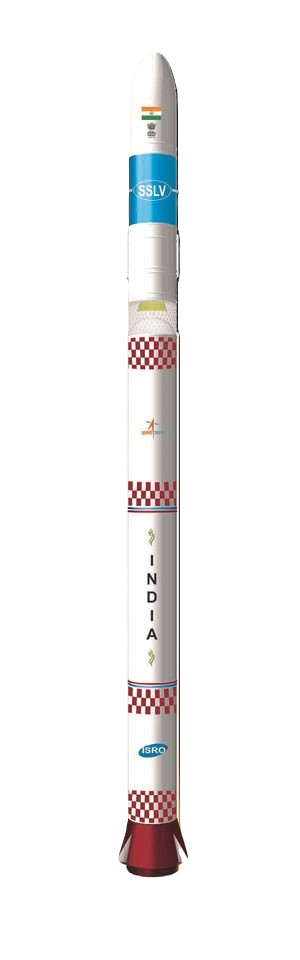
Small Satellite Launch Vehicle. Designed for the new space economy — rapid assembly, minimal launch infrastructure, low cost. India's answer to Rocket Lab and Virgin Orbit.
Height
34
metres
Liftoff Mass
120
tonnes
Stages
3
All Solid + VTM kick
Payload to LEO
500
kg @ 500 km
Payload to SSO
300
kg @ 500 km SSO
Assembly Time
72
hours
SSLV
No 3D model available
VTM
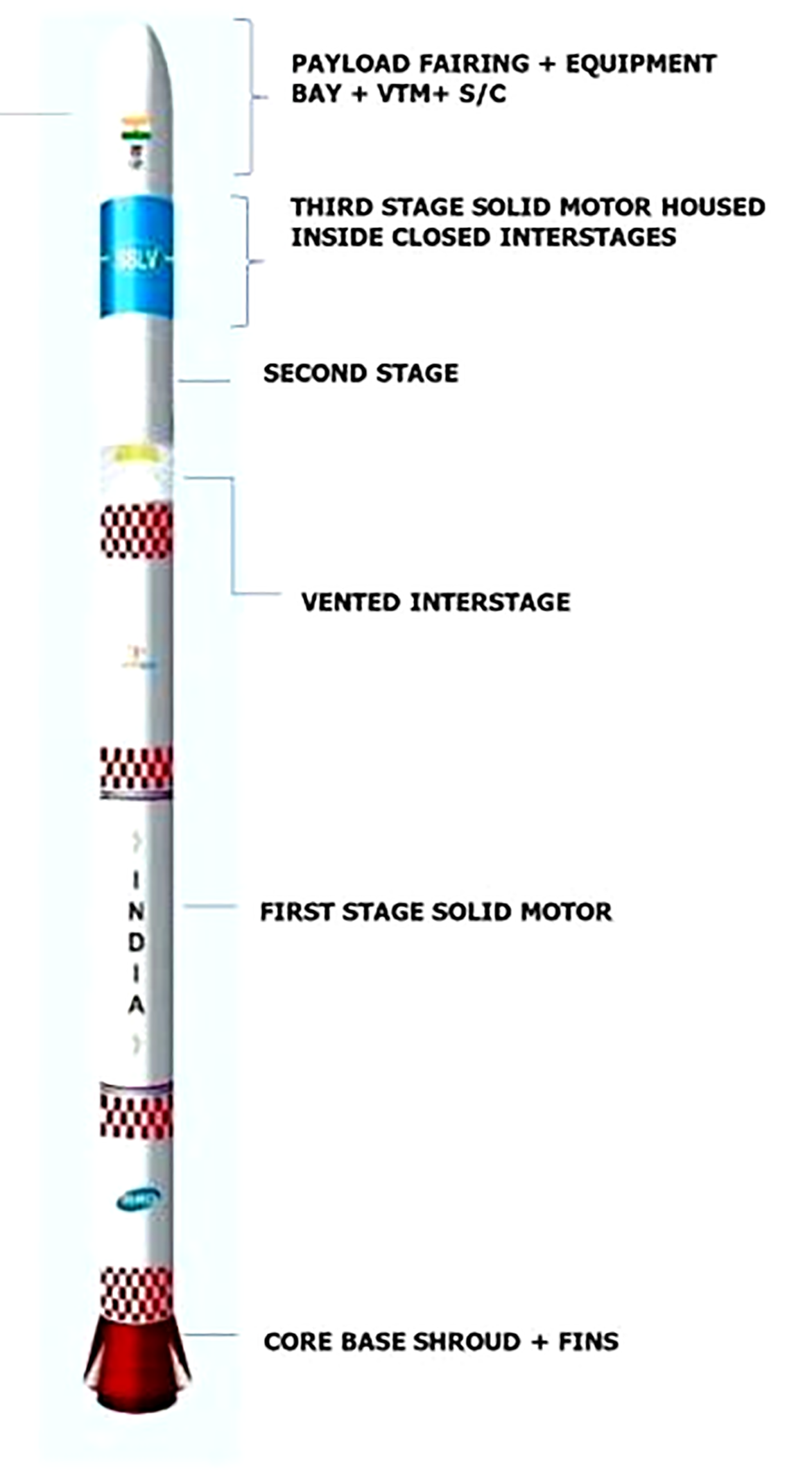
Velocity Trimming Module — Liquid (MMH/MON-3) · precision kick
Stage 3
SS3 — Solid (HTPB)
Stage 2
SS2 — Solid (HTPB)
Stage 1
SS1 — Solid (HTPB) · 1,640 kN

SSLV's solid stages cannot be throttled once ignited — so the Velocity Trimming Module (VTM), a small liquid stage using MMH/MON-3, provides precise orbital fine-tuning after the solids finish. It's the difference between "approximately right" and "exactly right."

SSLV can be assembled in 72 hours with minimal ground infrastructure — designed specifically for the commercial small satellite market. After a sensor failure on SSLV-D1 (2022), SSLV-D2 (2023) succeeded perfectly and the vehicle is now available commercially via NewSpace India Limited (NSIL).

In Development

Next Generation

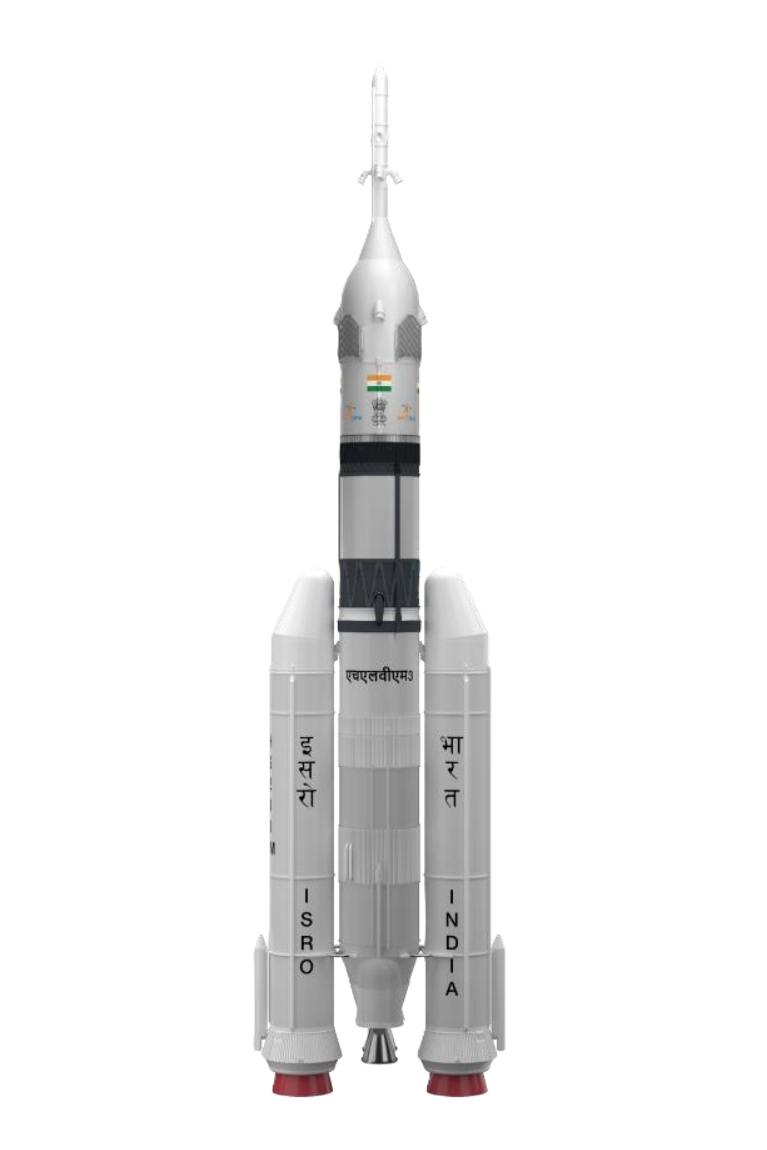
HLVM3
Human-Rated LVM3. LVM3 upgraded for human spaceflight — Crew Escape System, full redundancy, human-rating certification. The rocket that will carry Gaganyaan astronauts, and later, modules for India's own space station (BAS).
Height (est.)
~45
metres
Crew Capacity
3
astronauts
Escape System
CES
Crew Escape System
Status
In Development
HLVM3
No 3D model available

The Crew Escape System (CES) can pull the crew module away from the rocket in under two seconds during any abort — from launchpad to ascent. The crew module is designed for re-entry at up to 8 g's and water landing, with recovery by the Indian Navy. Every system must meet human-rating requirements that go far beyond normal satellite launch standards.

RLV-01
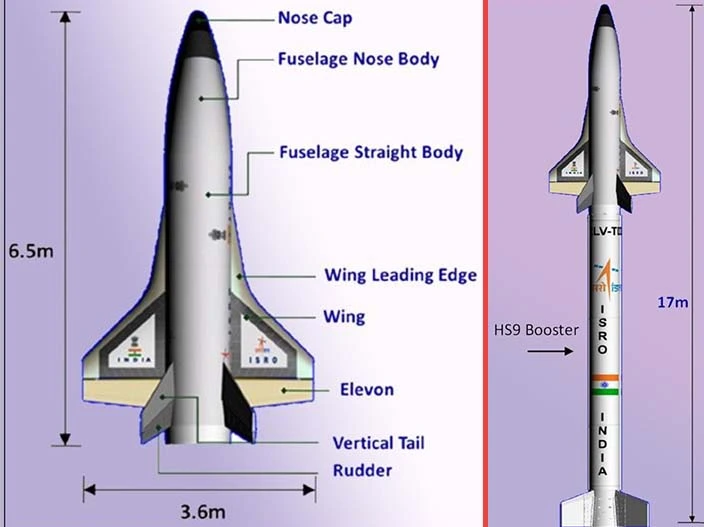
Reusable Launch Vehicle. After HEX, LEX, and REX demonstrator successes — hypersonic re-entry, autonomous runway landing proven — RLV-01 is the full orbital version targeting 10× cost reduction through vehicle reuse.
Type
Winged
Orbital Reusable
Landing
Runway
Autonomous
Cost Target
10×
reduction vs expendable
Status
In Development
RLV-01
No 3D model available

RLV-01 is the culmination of HEX (Hypersonic Entry), LEX (Landing Experiment), and REX (Return Flight Experiment) — all proving autonomous re-entry and precision runway landing. The full orbital vehicle launches on an expendable booster, delivers payload to orbit, re-enters autonomously, and lands on a runway for reuse. TPS (Thermal Protection System) uses Carbon-Carbon composites and silica tiles. FADS and onboard AI handle autonomous approach and touchdown.

ISRO Launch Vehicles