● Pioneer · First Indian Comms Satellite · Jun 19, 1981

APPLE

A satellite carried to its launch site on a bullock cart. A nation that couldn't afford a truck used what it had. And then put a geostationary communications satellite into orbit. This is the story of APPLE — India's most improbable space triumph.

Watch: APPLE Satellite Story
1st
Indian Comms Satellite
1981
Year of Launch
670kg
Spacecraft Mass
GEO
Geostationary Orbit
2yr
Mission Life
Overview The Bullock Cart Spacecraft Results Legacy

India's First Communications Satellite

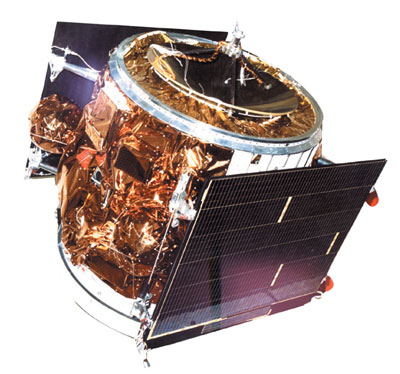
APPLE — Ariane Passenger Payload Experiment — was India's first experimental geostationary communications satellite, launched on June 19, 1981, aboard ESA's Ariane-1 rocket from Kourou, French Guiana. It was the first Indian satellite to be placed in geostationary orbit — 36,000 km above Earth's equator — where it could serve as a fixed relay point for television and telecommunications signals across all of India.

APPLE was built entirely by ISRO scientists with no prior experience building a geostationary satellite. It was designed to test communication technologies that would form the backbone of India's future INSAT satellite series — the series that eventually brought television to India's villages.

The mission succeeded. APPLE operated for nearly two years, validating communication technologies and demonstrating that India could build and operate a geostationary satellite. The INSAT series that followed — and everything India's communication infrastructure is built on today — began with APPLE.
Launch Date
Jun 19, 1981
Launch Vehicle
Ariane-1 (ESA)
Launch Site
Kourou, French Guiana
Mass
670
kg
Orbit
Geostationary
Altitude
36,000
km
Design Life
2
Years
Full Name
Ariane Passenger Payload Experiment
The Iconic Moment

The Bullock Cart

The image is burned into Indian space history: APPLE being transported to its test site at Thumba Equatorial Rocket Launching Station (TERLS) on a wooden cart pulled by bullocks — for two simultaneous engineering reasons. First, the cart's slow, smooth movement caused far less vibration than any motor vehicle. Second — and less known — the cart's wooden construction meant zero metallic electromagnetic interference, allowing engineers to precisely test and measure APPLE's antenna radiation patterns during transport without the distortion a metal truck body would have caused. The bullock cart was not poverty — it was the optimal test fixture.

The engineers reasoned that a bullock cart's slow, smooth movement would cause less vibration than any motor vehicle available. They were right. The satellite arrived intact. It launched successfully. It worked.

The photograph of APPLE on the bullock cart became the most famous image in Indian space history — a symbol of India's ability to solve problems with ingenuity rather than money. It was shared globally. It told the world that India reaches space not because it has resources, but because it has brains.

The Engineering Logic
The decision to use a bullock cart wasn't poverty — it was engineering judgement. A bullock's walking gait produces far lower vibration frequencies than a motor vehicle on India's roads of the time. The satellite's sensitive components needed protection. The engineers found the optimal solution. That is what ISRO does.
Jugaad at Its Finest
The bullock cart image has been used in global presentations about India's space programme for over four decades. It distills everything: frugal, ingenious, determined engineering that produces world-class results from unexpected means.
Technology

What APPLE Tested

APPLE carried a C-band transponder with two channels — capable of relaying television signals, telecommunications, and radio communications across India from its geostationary position. The satellite tested station-keeping in geostationary orbit, attitude control using momentum wheels and thrusters, thermal management at GEO altitude, and ground-satellite communication protocols.

All of these technologies were directly transferred to the INSAT (Indian National Satellite) series that followed — INSAT-1A, 1B, 1C, 1D — which became the backbone of India's national communication infrastructure. Every satellite TV antenna in India, every doordarshan transmission to a remote village, every telephone call routed through satellite — traced back to what APPLE proved was possible.

Band
C-Band
Transponders
2
Stabilisation
3-Axis (Spin)
Power
Solar Panels
Successor
INSAT Series
ESA Collaboration
Ariane-1 Launch
Results

What It Proved

🔧
ISRO's First Deep Space Rescue — The Stuck Solar Panel
Shortly after reaching geostationary orbit, one of APPLE's solar panels failed to deploy — leaving the satellite with only half its expected power. ISRO engineers performed India's first in-orbit spacecraft rescue: carefully tilting the entire satellite's orientation to balance thermal loading and maximise power from the single deployed panel. APPLE operated successfully for two years on half its power — through sheer engineering ingenuity.
📡
GEO Technology Validated
APPLE proved India could build and operate a geostationary satellite — the most demanding class of satellite to operate, requiring precise station-keeping 36,000 km above Earth. ISRO had never done it before. They did it correctly on the first attempt.
📺
Television Transmission Testing
APPLE successfully relayed television signals across India — a proof of concept for the national satellite TV network that would follow. The technology was directly adopted by INSAT, which brought Doordarshan to hundreds of millions of Indians.
🤝
ESA Partnership Established
APPLE flew as a passenger on Ariane-1 — ESA's then-new rocket. This partnership between India and ESA established a relationship that continues today, with ESA contributing instruments to Chandrayaan-1 and collaborating on Aditya-L1 science.
📶
Telecommunications Backbone Born
The INSAT series that followed APPLE — 20+ satellites spanning four decades — became India's telecommunications backbone. Weather forecasting, disaster warning systems, direct-to-home television, and telemedicine in remote areas. APPLE made all of it possible.
Legacy

From Bullock Cart to Broadband

APPLE's legacy is not just technical — it is cultural. The bullock cart photograph became India's most famous space image. It appeared in textbooks, documentaries, international presentations, and became a symbol of Indian jugaad engineering recognised globally.

More concretely: APPLE's technology directly seeded the INSAT programme. The INSAT series brought television, telephone connectivity, and weather data to India's most remote corners. Fishermen in Kerala, farmers in Rajasthan, and students in the northeast India all benefited — tracing a direct line back to the satellite that rode a bullock cart to its test.

Next Pioneer
Rohini — India's Own Rocket
SLV-3 · 1980 · APJ Abdul Kalam
Explore Mission → All Missions