×
● Active · India's Space Telescope · Since 2015

ASTROSAT

India's own space telescope — studying black holes, neutron stars, and galaxies simultaneously across X-ray and ultraviolet wavelengths that ground-based telescopes can never see. AstroSat has been India's eye on the violent, energetic universe for over a decade.

Watch: AstroSat Mission
1st
Indian Space Observatory
5
Science Instruments
10+yr
In Operation
1,650kg
Spacecraft Mass
Active
Status · 2026
Overview 5 Instruments Discoveries Significance

India's Eye on the Violent Universe

AstroSat — launched on September 28, 2015 — is India's first dedicated multi-wavelength space observatory. Unlike most telescopes that observe in a single wavelength, AstroSat simultaneously observes celestial objects in visible light, ultraviolet, soft X-ray, and hard X-ray — giving astronomers a complete, multi-energy picture of the most energetic phenomena in the universe.

Placed in a 650 km equatorial orbit, AstroSat studies black hole accretion, neutron star spin, pulsar timing, active galactic nuclei, and star-forming galaxies. It has produced over 800 peer-reviewed scientific publications and provided data to researchers in over 20 countries through ISRO's open data policy.

AstroSat's unique capability to observe simultaneously in multiple wavelengths — something Hubble cannot do — makes it scientifically complementary to every other space telescope in operation. India didn't build a copy of Hubble. India built something different and irreplaceable.

Launch Date
Sep 28, 2015
Launch Vehicle
PSLV-C30
Mass
1,650
kg
Orbit
650
km Equatorial
Instruments
5
Papers Published
800
+ peer-reviewed
Countries Using Data
20
+
Status
Active · 2026
Science Payloads

5 Instruments · One Complete Picture

The Multi-Wavelength Advantage
The universe's most energetic events — black hole mergers, neutron star collisions, gamma-ray bursts — emit radiation across all wavelengths simultaneously. A single-wavelength telescope sees only one part of the story. AstroSat sees all five chapters at once. This simultaneous multi-wavelength capability is what makes it scientifically unique.
🔭
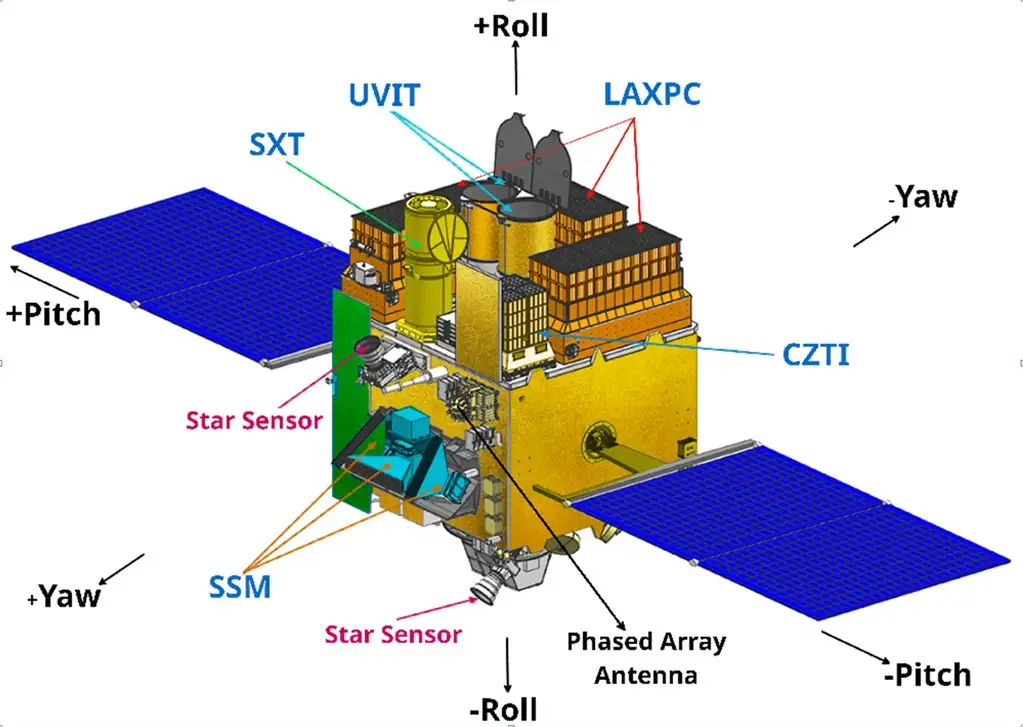
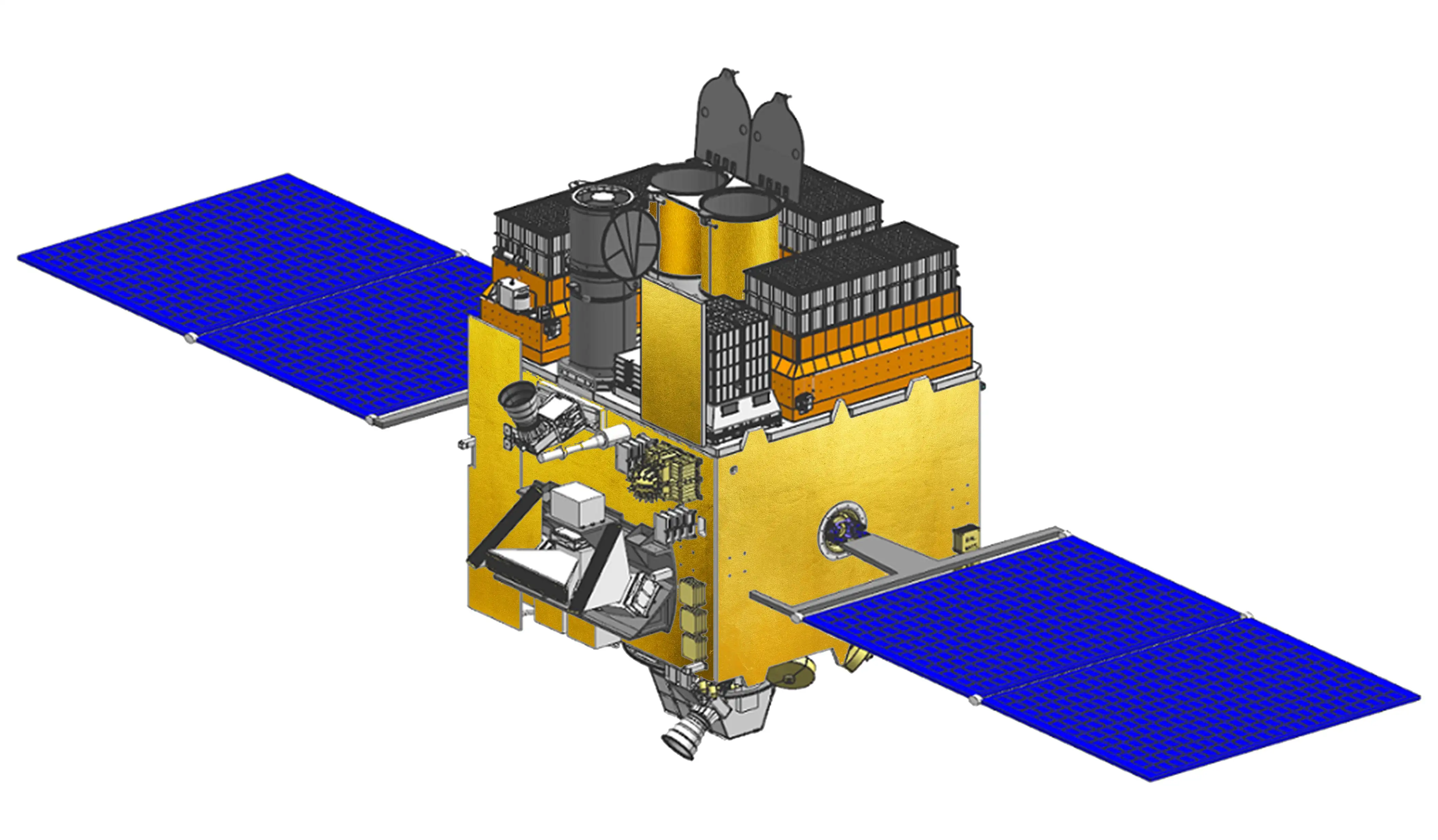
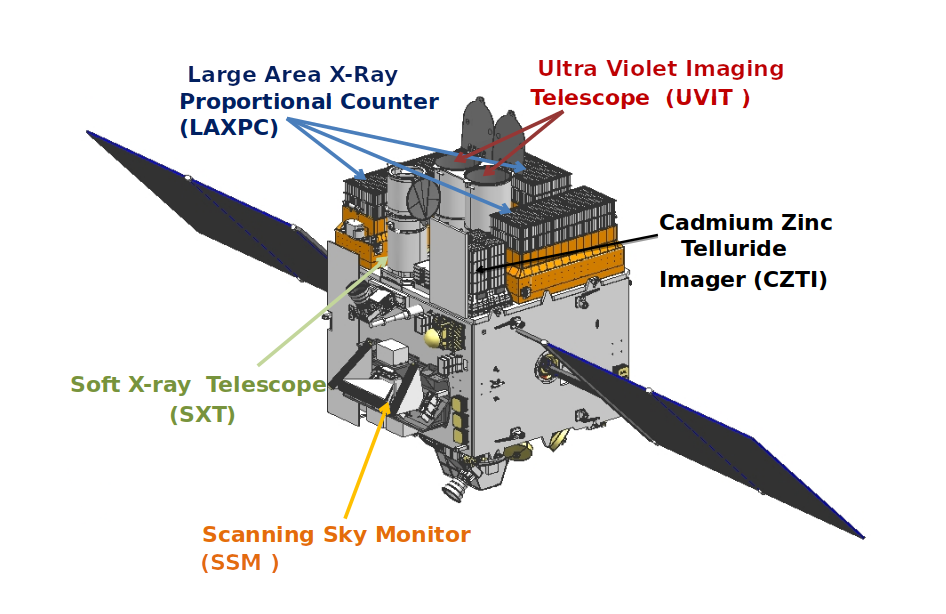
UVIT — UV Imaging Telescope
Ultraviolet Imaging Telescope — two telescopes in one, imaging in far-UV and near-UV simultaneously. Observes hot young stars, star-forming regions, and galaxies in UV light invisible from Earth's surface.
SXT — Soft X-ray Telescope
Studies soft X-ray emission (0.3–8 keV) from hot plasma around black holes and neutron stars. India's first focusing X-ray telescope — similar in concept to NASA's Chandra but complementary in capability.
💥
LAXPC — Large Area X-ray Proportional Counter
The largest X-ray detector India has ever flown — covering 3–80 keV. Measures rapid time variability in X-ray sources with microsecond precision. Early in the mission, one of LAXPC's three detector units developed a tiny gas leak — ISRO scientists carefully managed operations across the remaining units to maintain full science productivity. LAXPC is also used to time the Crab Pulsar with such precision that AstroSat data is used by international observatories worldwide to calibrate their own X-ray timing instruments.
🌟
CZTI — Cadmium Zinc Telluride Imager
Hard X-ray and soft gamma-ray imaging (10–100 keV). Used to detect and study Gamma-Ray Bursts — the most energetic explosions in the universe. Has detected over 600 GRBs during its lifetime.
🧲
SSM — Scanning Sky Monitor
Continuously scans the sky for new X-ray transients — sudden brightening of X-ray sources like black hole binary outbursts and neutron star explosions. AstroSat's early warning system for dramatic cosmic events.
Science Highlights

What AstroSat Has Found

🌌
Earliest Ultraviolet Light — 9 Billion Years Ago
In 2020, AstroSat detected the oldest ultraviolet light ever observed from a galaxy — the Extremely UV bright galaxy AUDFs01, emitting UV light 9 billion years ago. A record-breaking observation that no other space telescope had achieved. India's space telescope saw further back in time than Hubble in UV.
Black Hole Spin Measurements
LAXPC's rapid timing capability has measured spin rates of several stellar black holes with precision not possible from ground-based observatories. These measurements constrain models of how black holes grow and evolve through accretion.
💫
600+ Gamma-Ray Bursts Detected
CZTI has detected over 600 gamma-ray bursts — cosmic explosions brighter than entire galaxies — since launch. AstroSat has contributed to the global GRB monitoring network, providing data that helps triangulate burst positions for follow-up observations.
⏱️
Crab Pulsar — Calibrating the World's Telescopes
AstroSat can time the Crab Pulsar's rotation — 30 rotations per second — with such extraordinary precision that its data is used by other international observatories to calibrate their own timing systems. India's space telescope is not just doing science — it is the standard against which other telescopes measure themselves.
🌠
Neutron Star Physics
AstroSat has studied multiple neutron stars — the densest objects in the universe short of black holes — measuring their magnetic fields, rotation periods, and surface temperatures. Data that directly tests theories of matter under extreme conditions.
Why It Matters

India in Astrophysics

AstroSat has positioned India as a serious player in global astrophysics research. Its open data policy means scientists worldwide — from Harvard to ESA to JAXA — use AstroSat data in their research. India built an instrument that the global scientific community depends on.

The 800+ publications from AstroSat data represent India's most significant contribution to fundamental physics and astronomy. This is science for its own sake — understanding the universe — and India is doing it at the highest level.

10+ Years and Still Going
AstroSat was designed for a 5-year mission. It is still operating in 2026 — over a decade in orbit, with all five instruments functional. ISRO's engineering has kept India's space telescope alive and producing science for twice its planned life. The universe has more to reveal, and AstroSat is still listening.

In Pictures

Swipe or click arrows to browse. Click any photo to zoom.
Back to All Missions
Explore All ISRO Missions
133+ Missions · Complete Archive
All Missions → Home