● Pioneer · India's First Satellite · Apr 19, 1975

ARYABHATA

On April 19, 1975, India became a spacefaring nation. Named after the 5th-century mathematician who calculated the value of pi and the length of the solar year — India's first satellite carried a name that told the world exactly who we are.

Watch: Aryabhata — India's First Satellite
1st
Indian Satellite Ever
1975
India Enters Space Age
360kg
Spacecraft Mass
93.4min
Orbital Period
5days
Active Science Ops
Overview Spacecraft Science Timeline Legacy

The Moment India Entered Space

Aryabhata — named after the legendary 5th-century Indian mathematician and astronomer — was India's first satellite and the beginning of everything. Launched on April 19, 1975, from the Soviet Kapustin Yar launch site aboard a Soviet Cosmos-3M rocket, it marked the moment India crossed the threshold from an Earth-bound nation to a spacefaring one.

The satellite was built entirely by ISRO — the first entirely Indian-designed and built spacecraft. The Soviet Union provided the launch. India provided the engineering. The collaboration was purely transactional: India needed a ride to orbit, and the USSR provided one.

Aryabhata's primary purpose was to demonstrate India's capability to build a functional satellite — to prove that an Indian institution could conceive, design, fabricate, test, and operate a spacecraft. On all counts, it succeeded. A power supply failure five days after launch curtailed the science mission, but the satellite itself orbited successfully for years.

Named After a Giant
Aryabhata (476–550 CE) calculated pi to four decimal places, correctly described Earth's rotation, calculated the length of the solar year to within 13 minutes of today's accepted value, and proposed a heliocentric model of the solar system — a thousand years before Copernicus. India named its first satellite after him. The symbolism was intentional and perfect.
Launch Date
Apr 19, 1975
Launch Site
Kapustin Yar, USSR
Launch Vehicle
Cosmos-3M (Soviet)
Mass
360
kg
Orbit
563 × 619 km
Inclination
50.7
degrees
Orbital Period
93.4
minutes
Re-entry
Feb 11, 1992
Spacecraft Design

Built in India

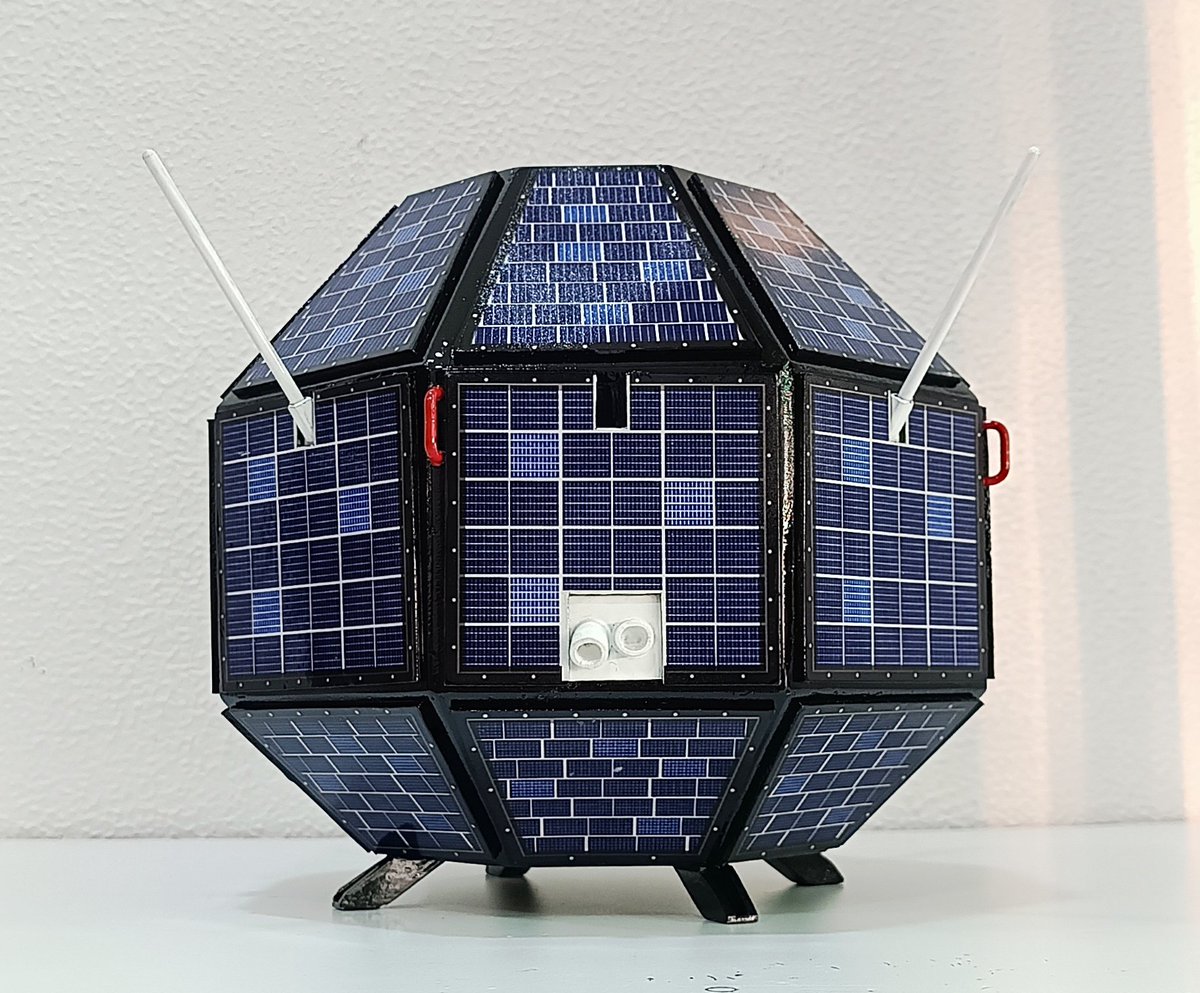
Aryabhata was a 26-sided polygon — a shape chosen because it approximated a sphere while being easier to manufacture with flat solar panels on each face. All 26 faces were covered with solar cells to generate power regardless of the satellite's orientation relative to the Sun.

The spacecraft carried three science payloads: X-ray Astronomy, Aeronomy (upper atmosphere studies), and Solar Physics. All three were developed by ISRO scientists — the first generation of Indian space engineers working on instruments with no precedent in India.

Five days after launch, a power supply failure disabled all science instruments. The satellite itself continued to orbit — its beacon transmitting — for 17 years, finally re-entering Earth's atmosphere on February 11, 1992.

26-Sided Polygon — An Engineering Choice
The 26-sided polyhedron shape maximised solar panel area while remaining manufacturable with India's facilities at the time. Every face had solar cells. The design ensured power generation across all orientations in orbit — a practical solution from engineers working with what they had.
Shape
26-sided polygon
Payloads
3
Power
Solar Cells (all faces)
Stabilisation
Spin + GN2 Active
Attitude Control
Gas Nitrogen (GN2) System
Science Payloads

Three Experiments

☀️
X-Ray Astronomy
Designed to study X-ray sources in space — cosmic objects like neutron stars and supernova remnants that emit high-energy radiation invisible from Earth's surface. A field India was entering for the first time.
🌐
Aeronomy
Studied the upper atmosphere — its electron density, composition, and how it interacts with solar radiation. Critical data for understanding radio wave propagation over India.
🌟
Solar Physics
Monitored solar neutrons and gamma rays — studying the Sun's energetic particle output. India's first contribution to solar science from space.
The Power Failure
Five days after launch — on April 24, 1975 — a failure in the +14.1V line of the power conditioner silenced all three science instruments. It was a blow, but not a defeat. The satellite itself remained in orbit, its structure and systems proven functional. The engineers learned. The next mission would be better. That is how space programmes grow.
Timeline

From Drawing Board to Orbit

1972
Project Approved
ISRO (formally established in 1969) receives approval to build India's first satellite. The project is named after Aryabhata. Design and fabrication begin at ISRO's facilities in Bengaluru.
1974–1975
Assembly and Testing
Aryabhata is assembled, integrated, and tested. Soviet engineers visit India to evaluate the satellite's compatibility with their Cosmos-3M launch vehicle. The collaboration works.
Apr 19, 1975
Launch — India Enters Space
Aryabhata lifts off from Kapustin Yar at 13:00 UTC aboard a Soviet Cosmos-3M rocket. It is successfully placed into orbit. India is now a spacefaring nation. The date — April 19 — is celebrated annually as National Technology Day.
Apr 24, 1975
Power Failure — Science Curtailed
Five days after launch, a power supply fault disables all three science instruments. The satellite continues to orbit and transmit its beacon — proving structural and basic systems integrity — but science operations end.
Feb 11, 1992
Re-entry — 17 Years in Orbit
Aryabhata re-enters Earth's atmosphere after 17 years in orbit — far beyond any mission plan. India's first satellite, true to its namesake, kept going long after anyone expected it to.
Legacy

Where Everything Began

🚀
The First Step
Without Aryabhata, there is no Chandrayaan. No Mangalyaan. No Gaganyaan. Every ISRO mission traces its lineage to the 360 kg polyhedron that proved India could build a satellite. The first step is always the hardest — and the most important.
🧑‍🔬
A Generation of Engineers
The scientists and engineers who built Aryabhata went on to lead every major ISRO programme for the next three decades. The project was India's space engineering school — hands-on, high-stakes, and formative.
🤝
The Soviet Partnership
India's use of a Soviet rocket was pragmatic — India had no launch capability yet. The partnership was professional, not political. India built the satellite; the USSR provided the ride. A clean transaction that helped a nation reach orbit for the first time.
🪙
On the 2-Rupee Coin
Aryabhata was commemorated on India's 2-rupee coin — the first time a space mission appeared on Indian currency. It was a statement: space is not separate from India's identity. It is central to it.
Next Pioneer
APPLE — India's First Comms Satellite
The Bullock Cart Launch · 1981
Explore Mission → All Missions